Labor Market Reform in a Business Cycle Framework
Abstract
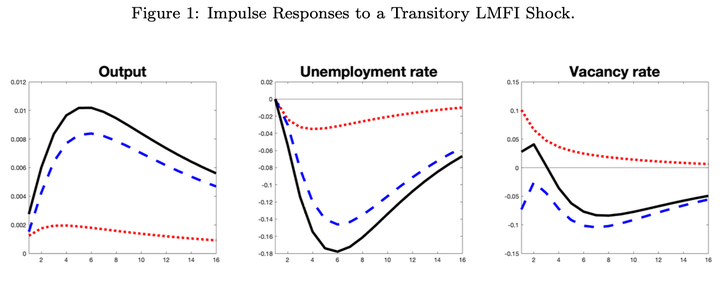
How does labor market reform contribute to business cycle dynamics? I develop a real business cycle model in which labor market reform affects economic activity both by improving employment matching efficiency and by reducing vacancy posting costs. I then use shocks to a labor market freedom index (LMFI) to proxy for labor market reform in the United States and calibrate the model assuming the labor market reform has two different components—improved matching efficiency and reduced vacancy posting cost—to test the empirical relevance of these two mechanisms. The results from the structural model show that, depending on the mechanism, a labor market reform can produce either a net positive or net negative impact on the vacancy rate. The impulse responses in a VAR framework for U.S. data and OECD data generate a positive net effect of the LMFI shock on the vacancy rate, similar to the result obtained from the structural model with the vacancy posting cost channel.