Capital Misallocation at the Intersection of Race and Gender: Evidence from Small Businesses (Job Market Paper)
Abstract
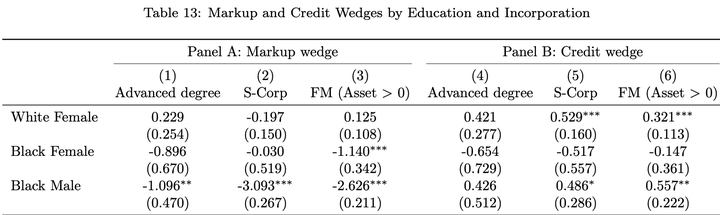
We ask whether the disadvantages facing minority- and women-owned firms stem from weaker product-market condition or differential credit access, and whether they differ at the intersection of race and gender. Using the restricted-access Kauffman Firm Survey, we study capital misallocation in a unified framework. Because average revenue products conflate output-price differences in capital marginal productivity, we estimate a two-step system that decomposes the average revenue product of capital into a markup wedge and a credit wedge. Relative to White male-owned firms, White female-owned firms show little output-market penalty yet remain undercapitalized; Black female-owned firms face weaker output-market conditions and higher loan-rejection rates, concentrated among smaller firms; and Black male-owned firms face the largest, most persistent markup wedges alongside positive credit wedges. Across groups, product-market disadvantages are at least as important as-and often larger than-credit frictions, except for White female-owned firms, whose central constraint is undercapitalization; pooled race-only or gender-only comparisons obscure this heterogeneity.