Money or Bonds? The Macroeconomics of Deficit Finance in the United States
Abstract
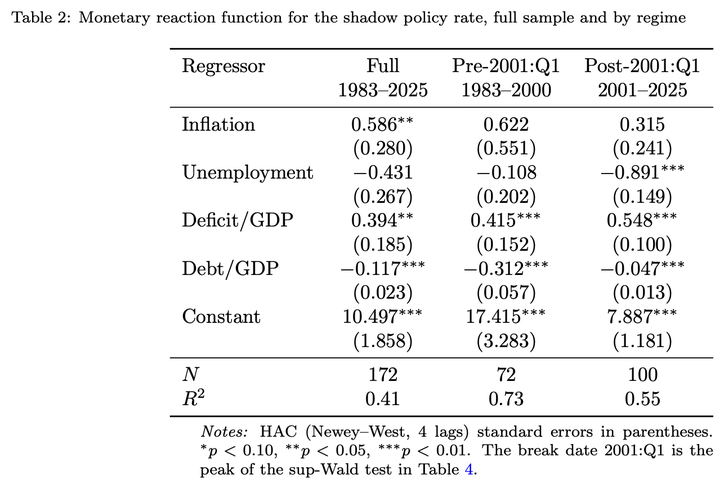
We reassess the endogenous monetary and fiscal policy model of Turnovsky and Wohar (1987) on United States quarterly data from 1983 to 2025, asking whether the composition of deficit financing has distinct effects and whether the rules governing policy have changed. Identifying money-financed and bond-financed deficit shocks in a structural vector autoregression, we find that the mode of financing matters. A bond-financed shock raises unemployment and lowers the real interest rate, a crowding-out pattern robust across identification schemes, while the money-financed inflation channel is weaker than the popular account of the recent inflation supposes. The monetary and fiscal reaction functions are unstable, with breaks near 2001 and 2019 and a fiscal rule that stops leaning against inflation after 2008. Long-run monetary neutrality holds only after 2001, so neutrality is a property the regime produces rather than a fixed feature of the economy. Applied to the recent inflation, the framework attributes a modest share of the 2021 to 2023 rise to deficit financing, concentrated in its money-financed component.