Revisiting the Quantity Theory of Money: Measurement and Filtering Perspectives
Abstract
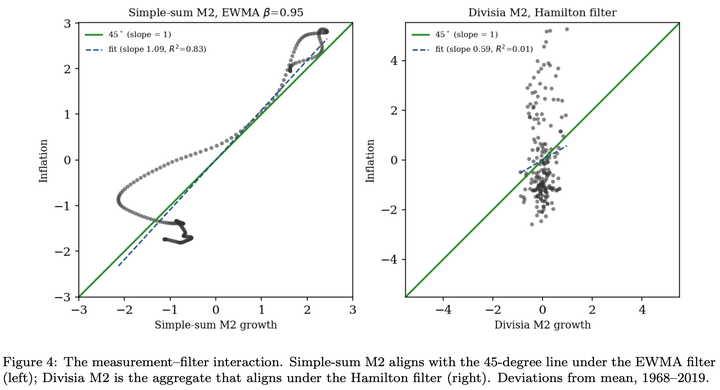
Lucas (1980) showed that the long-run predictions of the quantity theory of money, a one-for-one link from money growth to inflation and to the nominal interest rate, emerge once short-run fluctuations are filtered from the data. This paper asks whether those predictions survive on a long modern sample, 1968–2019, when money is measured with Divisia aggregates rather than simple sums and trends are extracted with the Hamilton regression filter rather than a moving average. Testing directly whether the money-growth slope equals one, with heteroskedasticity- and autocorrelation- consistent inference throughout, we find that it does for Divisia M2 and MZM under the Hamilton filter, while simple-sum aggregates and the moving-average filter succeed only in narrow cases. The relationship is conditional rather than universal: it is unstable across sub-periods and reappears only when inflation is high. In levels, broad money and prices share a long-run relationship whose elasticity returns to one once output growth and the opportunity cost of money are taken into account. Extending the data through 2024, the 2021–2023 inflation confirms the pattern out of sample, as broad money growth led the surge and a money-based price gap signaled it in advance. Properly measured and properly filtered money thus recovers the quantity-theoretic relations over the long run, though their appearance depends on the monetary measure, the filtering method, and the inflation regime.